• Skip to primary navigation
  • Skip to main content
  • Skip to footer
Alicia Hauff Studio

Alicia Hauff Studio

Mixed Media Fine Artist in Fargo, ND

0
  • Original Work
  • Shop
    • Available Original Paintings
      • Seize the Day
    • Fine Art Prints
    • Wild Ink Sketches and Sets
    • Studio Sale
  • More
    • Trade Program
    • Commission Process
    • About
    • Testimonials
    • FAQ
    • Studio Blog
  • Contact + Visit
    • Visit the Studio
  • Search
    Close

Studio Blog

Creative Identity and Ritual: Lessons from Inktober

IMG_8250

"I believe that true identity is found in creative activity springing from within. It is found when one loses oneself."

-Anne Morrow Lindbergh

Every artist asks the questions: who am I? Where do I and my art fit in? What art do I even make or want to be known for? These and many other questions have been swirling. I asked my mother recently, "is there a memory you have of the moment you thought, 'That girl is an artist'? "

Her response was comforting and not surprising. "It's more like a collage of memories of you totally locked in when you were creating. The whole world slipped away. You were all in. That photo of you looking at me with your earphones on at our kitchen table is what I feel when I think of your life of art. 100% in the process."

All in.

She was referring to a state of "flow," characterized by a balance between challenge and skill with an intrinsic reward. (If you've seen the film Soul, you know.) You can read more about this psychology here (it's very interesting). How anyone gets into a flow state is based on the individual. I do know, however, that that activity is based on following your spark--what lights you up. What keeps drawing you back and in. What keeps you awake at night or restlessly daydreaming during the day. What makes you giddy.

Creative Identity

Whether it's a blank canvas, screen, or room, every creative person faces the same decision: start making something, or quit. Make something that has never existed before, or abandon ship. It's a wild thought.

I'm reading "The Creative Habit: Learn It and Use It For Life" by Twyla Tharp. Chapter 2 discusses rituals of preparation--the things we do to set ourselves up for creative action and flow. Habits are strong patterns of behavior that can be honed for creative success. How and when do you begin your day? Where do you create? What do you surround yourself with, and what tools do you use? Do you listen to music, or is that too distracting? What music?

One week I was struggling with a painting. It wasn't telling me what it needed, and I couldn't see how to finish it. My kids all had tennis practice that evening, so I went into the studio for 90 minutes. I turned on some rock music (AD/DC, Foo Fighters, and the like) and basked in being completely alone in the whole building. I painted with ease and finished it the next day. Sometimes it pays to switch it up, even though I am talking about creating habits.

I always write at night. It's the only time everything is finally quiet, and I can hear my thoughts again. I wrote my whole dissertation at night for FNP school; I felt chained to that desk, but I got it done. I'm still learning about how I create and what the common thread is. I can tell you a primary factor is being utterly left alone, without distraction. Only then can I sink into that flow state.

Twyla writes, "...a little self-knowledge goes a long way. If you understand the strands of your creative DNA, you begin to see how they mutate into common threads in your work. You begin to see the "story" that you're trying to tell; why you do the things you do (both positive and self-destructive); where you are strong and where you are weak (which prevents a lot of false starts), and how you see the world and function in it."

Creative identity is more than artistic style and voice. It's how you creatively process and function. I just met an artist who stares at the corner of a room until she gets a breakthrough--cutting out stimuli to allow her creative flow of ideas. White noise, no noise; once you figure out how you creatively tick, creativity flows.

When you have a "Eureka!" moment, take note of the factors that may have helped you get to that moment. Or what helps you mentally switch gears, to reset. And, of course, what factors you can control.

AliciaHauff-2022-14

Inktober & Creative Ritual

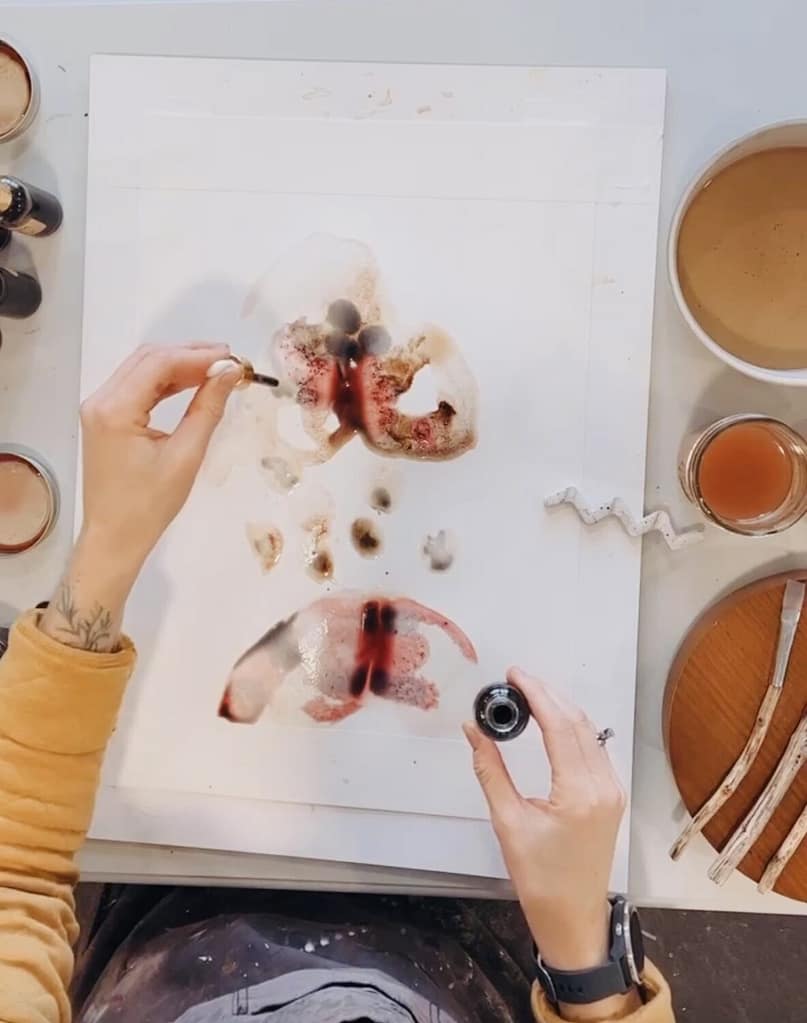
If you're not familiar with Inktober (I only learned about it last year), it's a month-long challenge to improve creative skills and habits. Artists create sketches according to the word prompts and share them online. I was asked in September to participate in a local business's Inktober gallery with other area artists. I saw it as a chance to start testing the wild inks I'd been making and see what comes of it.

Here are a few key takeaways from that month:

  • This was indeed a challenge. I didn't feel like doing it some of the days, or the word prompt wasn't really inspiring. But I showed up and did them anyway (I played catchup and did three on Mondays!).
  • It brought me back to painting some realism, which was both frustrating and rewarding. Switching gears made me appreciate my abstract lean even more.
  • I learned how the wild inks blend and sit with each other on paper. The results were absolutely delightful.
  • Creative exercises with set limitations (in this case, the prompt) get you to focus and move past your inner critic.
  • I started my days in the studio with my ink sketches and shared them on Instagram. It became my little morning studio ritual and warm-up.
  • It was all more time-consuming than I anticipated, but I created things I would never choose to create otherwise. (Except booger. Nope. I refused.)

Now that Inktober has been over, I am taking what I learned last month and starting most of my studio days with a larger wild ink sketch (series is on the way). Same ritual, different subject matter. It might be time to start making my tea again in the studio...
Tell me in the comments: what are your creative rituals?

What makes you tick?

Thanks for reading.

A World of Color: Natural Ink Making

AliciaHauff-2022-69

A Sense of Place

I have tried to answer the question "how did I get here?" with natural ink. The truth is I do not remember any one thing that led me here. After nearly a full year in this professional art business, I know that my creative path (and I would guess most others') is like a breadcrumb trail.  The trail has taken me from watercolor class to acrylic paper making, to eco printing, and to natural ink making in one year. I am finding my way in the world of creative expression--and understanding my need for connection to the earth. Grounding. Freeing. The fresh air. The wild.

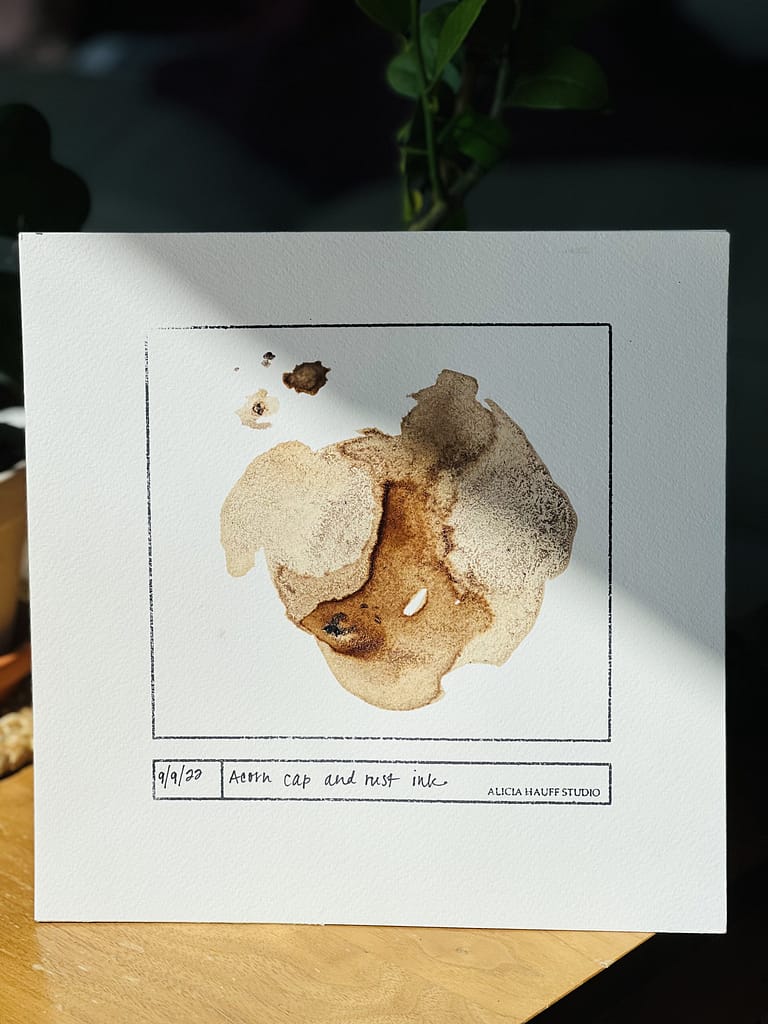
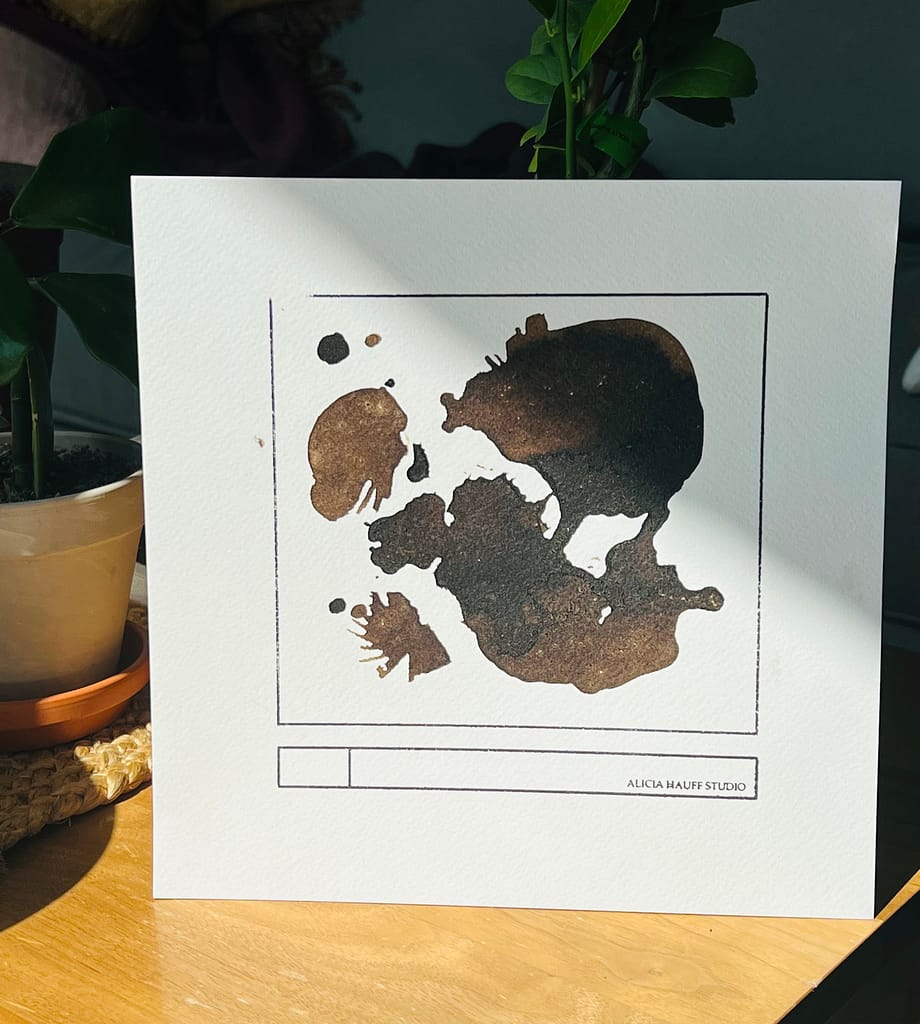
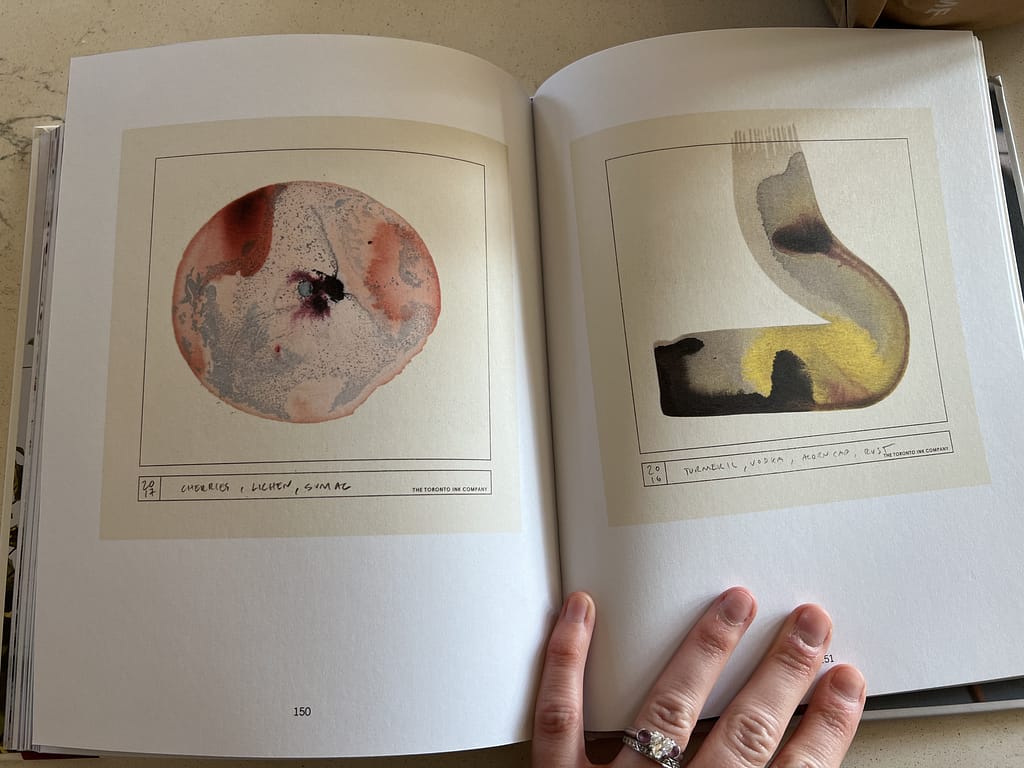
I previously shared about my foraging and the Honorable Harvest, and the foraging experience continues to be a serendipitous venture. Every walk I take seems to lead to surprising finds. I thought oak galls (small round brown balls that grow on oak branches) would be difficult to find, yet an oak tree along the boulevard near my house had a large cache of them. Now I can make the famous oak gall black ink used to write the Magna Carta and Beowulf. Learning the history of pigments and inks can be just as fascinating as finding the ingredients. On an evening walk, I noticed some bright yellow-topped bushes in the open field along a pond south of our house. I snapped a photo to identify it and was delighted to find it was goldenrod---and it was everywhere. The best acorn caps for gray ink were right along the boulevard entering my neighborhood. The abundance of natural color sources continues to amaze me and fills me with a sense of gratitude and place.

Natural ink making is like creating twice: the creation of the ink, then creating with the inks that were made. I can alchemize part of a place into color(s). How amazing is that? Ink making finds a purpose in what otherwise is overlooked, even discarded, similar to eco printing. I am simultaneously deepening my relationship with the places I inhabit; it is grounding.

The Kitchen Lab

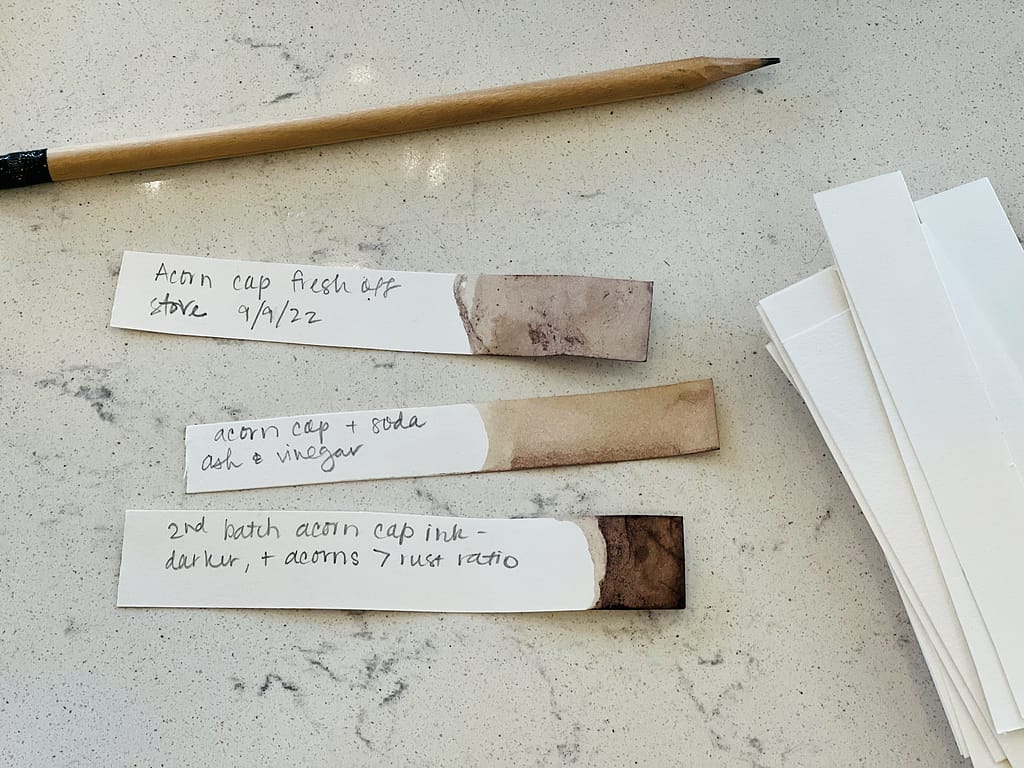
This past week I was home with COVID and boy, it kicked my ass for a few days. I am still a little deconditioned and coming out of the brain fog. However, I promised myself I would try my first batch of ink and just get going. The oak gall ink is still in progress, needing to soak for a few days. What I was able to make the same day were an acorn cap gray and a rich dark black walnut brown. The first batch of acorn cap color was higher in rust to acorn ratio, but I like having variations of the colors. I created a short video here:

View this post on Instagram

A post shared by Alicia Hauff Studio (@aliciahauffstudio)

And here are a few photos from the day. I am recording and archiving all the test strips and steps I take. The final ink portraits are in progress, as I may add another color or two once created.

On the Inking Docket & Beyond

There is something very liberating about sourcing my own ink materials. I am already training my eye to see more, to be more mindful and conscious. Open mind, open eyes.

So what's next? I hope you'll follow along on this ink making journey. The materials yet to be transformed include: serviceberries, chokeberries, oak bark, birch bark, pigmented rocks, clay, and goldenrod, to name a few. Harvest season is such a great time for foraging.

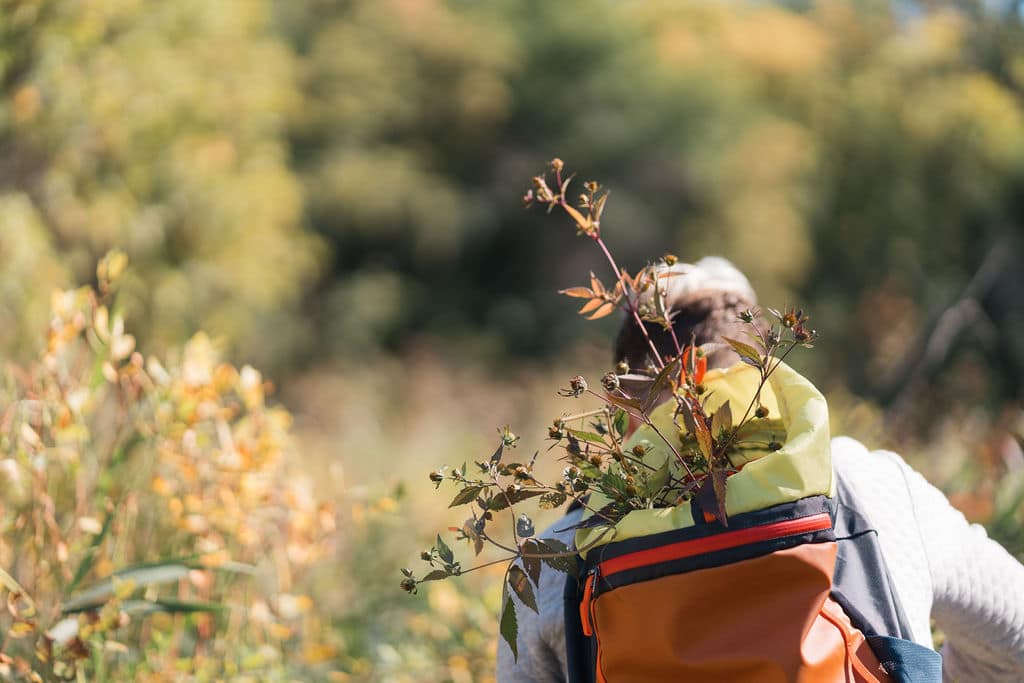
The week after Halloween I will be sharing the eco printing process with my 7 year-old son's class. His teacher excitedly told me about how she wants to introduce the concept of art with nature, and I am very happy to share what I have learned. I have been collecting materials for them on my evening walks and trail hikes.


Cheers and happy harvest season!

Inktober is upon us!

Three Tips for Commissioning Artwork

Commissioning an artist to create a custom work can feel daunting. Having completed several commissions as a professional artist, I gathered some insight (when am I not?!)  to share about this process. Many articles on the web discuss this, and I encourage you to do your research. I do not cover how to find an artist for commission, but I am aware of organizations and sites being able to assist with that.

Below are three takeaways from my experience thus far!

1. Know what you want.

Expect the artist to ask a lot of questions about the commission. To deliver the best experience and product, clear communication is vital. There are essential items such as size, a budget range for the work, what type of work (abstract, realistic), and color palette. Be ready to provide photos of the space where the work will reside, swatches of paint or textile color if possible, and any other helpful style details.

One other helpful hint is to let the artist know if you prefer progress photos. I recently asked a client for feedback based on some progress photos before proceeding with her commissioned work. She kindly mentioned that it was stressful to provide input as she did not want to “put the painting out of balance.” She loved the right half, felt the left half needed some lightening of a dark blue color, and asked if I would “tie it all together somehow.” I told her it was all great feedback and that it was my job to ensure the work was balanced and completed to her satisfaction. She ended up coming to see it in person and loved it.

2. Get to know the artist’s style and price point.

I am speaking as a mixed media artist with different styles here. I typically ask if an interested client has a favorite painting of mine and what the client loves about it. It can be the design, the colors, the textures, the subject, or a mix of all these things. Every artist has a primary style or two and dabbles in others. However, style can also include color palettes (bright versus muted/earthy), certain mark-making, specific media/materials, and composition.

Price points can feel awkward to discuss, but it is helpful. It is influenced by demand, competition, and perceived value. It costs a lot to create artwork. Consider the labor, including the initial research/mental labor of designing a composition and sketches. The physical labor includes creating the work–prepping the canvas, painting, and the finish work. Materials must be bought and accounted for, including brushes, canvas/paper, paint, matboard, tools, and other media. The last two items are more nebulous but need to be accounted for in an art business: overhead (rent, child care, utilities, marketing, etc.) and profit percentage. Why profit and not just labor? Growth of the company! I believe in transparency and am happy to discuss these details with my own business.

For further reading on this as an artist, I recommend visiting www.springboardforthearts.org. I am not affiliated nor receive any compensation for this mention.

3. Strive for clear communication and roles.

As stated previously, clear communication is vital, as are the roles of the artist versus the client. The artist gathers the essential data and begins the conversation to clarify the client’s desires. The artist negotiates a price and plan that reflects the value of the work and adheres to the budget. Most artists then create a contract outlining a timeline, rights, what is being made, a termination fee, and the final price, including shipping and sales tax. I researched a lot of contract templates before finding one that was as brief and clear as possible. One client did not even want to read the contract; she said she “trusted me.” I advised her that the contract is like an anchor of accountability and legal protection for the artist.

There must also be a balance between the artist’s “creative license” and the client’s wants for the artwork. This language can be outlined in the contract and verbally (I allow up to 5 minor changes to a work before further fees). It is primarily the artist’s job to delineate this along the way. I appreciated the client who did not want to take away from my style and skill, but I also wanted her to love her final painting. It is a dance!


What do you think? I would love to hear about your experience as an artist or client. Please share with me below!

If you found this helpful, let me know as well!

Thanks for being here. 


Footer

  • Original Work
  • Trade Program
  • Shop
    • Available Original Paintings
    • Fine Art Prints
    • Studio Sale
  • About
  • Refund and Returns Policy
  • FAQ
  • Contact + Visit
  • Testimonials
  • Email
  • Instagram
Photography by Britta the Photographer
Co-manager and administrator Stacey Bartron

Copyright © 2026 Alicia Hauff Studio | Privacy Policy | Refund and Returns Policy | Site Credits

This website or its third-party tools process personal data.
In case of sale of your personal information, you may opt out by using the link Do not sell my personal information.
×
Manage consent

Privacy Overview

This website uses cookies to improve your experience while you navigate through the website. Out of these, the cookies that are categorized as necessary are stored on your browser as they are essential for the working of basic functionalities of the website. We also use third-party cookies that help us analyze and understand how you use this website. These cookies will be stored in your browser only with your consent. You also have the option to opt-out of these cookies. But opting out of some of these cookies may affect your browsing experience.
Necessary
Always Enabled
Necessary cookies are absolutely essential for the website to function properly. These cookies ensure basic functionalities and security features of the website, anonymously.
CookieDurationDescription
cookielawinfo-checkbox-analytics11 monthsThis cookie is set by GDPR Cookie Consent plugin. The cookie is used to store the user consent for the cookies in the category "Analytics".
cookielawinfo-checkbox-functional11 monthsThe cookie is set by GDPR cookie consent to record the user consent for the cookies in the category "Functional".
cookielawinfo-checkbox-necessary11 monthsThis cookie is set by GDPR Cookie Consent plugin. The cookies is used to store the user consent for the cookies in the category "Necessary".
cookielawinfo-checkbox-others11 monthsThis cookie is set by GDPR Cookie Consent plugin. The cookie is used to store the user consent for the cookies in the category "Other.
cookielawinfo-checkbox-performance11 monthsThis cookie is set by GDPR Cookie Consent plugin. The cookie is used to store the user consent for the cookies in the category "Performance".
viewed_cookie_policy11 monthsThe cookie is set by the GDPR Cookie Consent plugin and is used to store whether or not user has consented to the use of cookies. It does not store any personal data.
Functional
Functional cookies help to perform certain functionalities like sharing the content of the website on social media platforms, collect feedbacks, and other third-party features.
Performance
Performance cookies are used to understand and analyze the key performance indexes of the website which helps in delivering a better user experience for the visitors.
Analytics
Analytical cookies are used to understand how visitors interact with the website. These cookies help provide information on metrics the number of visitors, bounce rate, traffic source, etc.
Advertisement
Advertisement cookies are used to provide visitors with relevant ads and marketing campaigns. These cookies track visitors across websites and collect information to provide customized ads.
Others
Other uncategorized cookies are those that are being analyzed and have not been classified into a category as yet.
SAVE & ACCEPT
×